
Palazzo Daniele: The Salento Palazzo Where Absence Is the Point
The Palombas took almost everything out of this 1861 Salento palazzo. What's left (frescoes, mosaic floors, four local cooks) is the point
Most of Puglia's famous addresses ask you to leave the world behind. The formula is by now well rehearsed: a whitewashed masseria (a fortified Apulian farmstead) at the end of a long private drive, a gate, an olive grove, a golf course, a spa menu roughly the length of a paperback. Palazzo Daniele does almost the opposite. It stands on the main square of Gagliano del Capo — a real, slightly sun-bleached working town near the very bottom of Italy's heel — behind a façade you could walk straight past without registering. Which is exactly the point. The prestige here isn't separation from the place. It's the chance to live, for a few nights, inside a nineteenth-century aristocratic family's home with almost nothing standing between you and its grandeur.
The palazzo went up in 1861 for the noble Daniele family and stayed with their descendants, the Petruccis, for five generations — a private house, frescoed and shuttered, on the square. It became a hotel in 2019 under the Roman hotelier Gabriele Salini, whose GS Collection also runs G-Rough in Rome. Rather than fill the rooms, Salini handed them to the Milanese designers Ludovica Serafini and Roberto Palomba and let them take almost everything out. The brief, in a single word, was absence. The judges at the AHEAD Europe awards rewarded the nerve of it that same year, naming Palazzo Daniele Hotel of the Year — and Best Guest Room alongside it.
 | 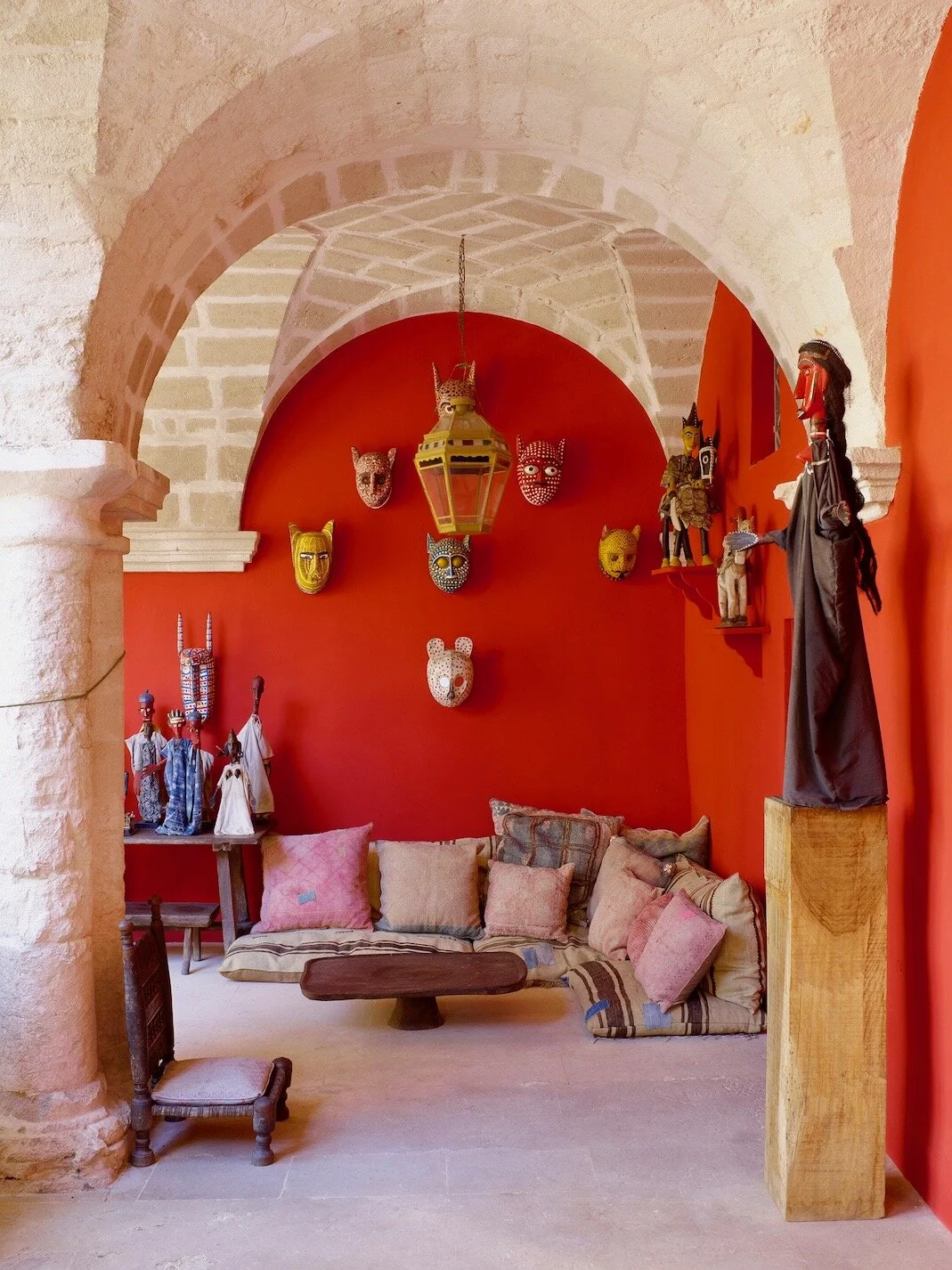 |
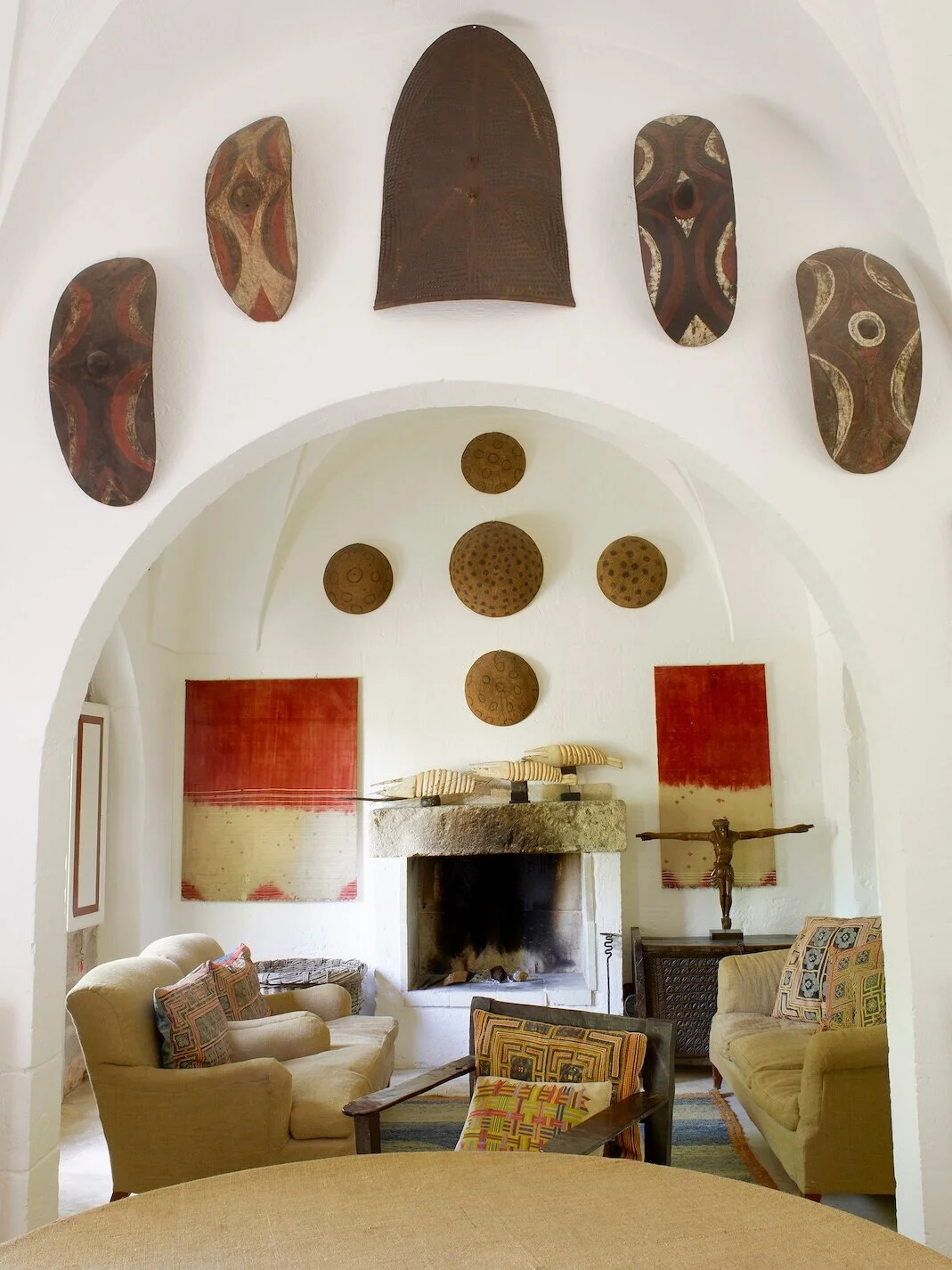
What "absence" means in practice is that the building is allowed to speak first. The Palombas stripped each of the nine suites back as far as it would go, then stopped, leaving the original frescoed ceilings and mosaic floors to carry the room. Walls are left bare and a little raw; a single contemporary artwork hangs where a noble family might once have crowded a dozen. The restraint reads as confidence: a room sure enough of its own bones to leave them mostly uninterrupted. In the Royal Junior Suite the one flourish is a six-meter rain shower that falls from the height of the vaulted ceiling into a stone basin sculpted by the Italian artist Andrea Sala — bathing reframed as a small piece of theater. Elsewhere a lightbox by Simon d'Exea doubles as the room's only ornament.
The suites are individual to the point of eccentricity, which is the opposite of the corporate ideal where a room in Gagliano should feel identical to a room in Singapore. The Black Suite is the clearest example: an 85-square-meter penthouse reached through an old concealed door and up a stone staircase, wrapped by a private terrace of some 1,500 square meters that circles the palazzo's central courtyard. La Torretta climbs a red-marble staircase to its own bathroom. None of them could be swapped for another, and none could be reproduced down the coast.

For all the design-press attention, the most telling thing about Palazzo Daniele is printed on its own kitchen page, and it is almost a provocation: "This house is not a hotel." The cooking is done not by an imported chef with a tasting menu to defend but by four women, each with generational roots in the Salento, working from what the local farmers bring to the door that morning. Breakfast and dinner arrive with the unforced quality of a meal in a family home that happens to have nine spare bedrooms. In a region where "farm-to-table" has long since hardened into a marketing slogan, here it is simply the staffing arrangement.
The town earns its place in the story too. Gagliano del Capo sits at de finibus terrae — the end of the earth, as the old maps of the heel had it — a few minutes from where the land gives out at Santa Maria di Leuca and the Adriatic and Ionian seas meet. It is not a resort town and makes no effort to become one. Once a year it hosts Capo d'Arte, an international contemporary-art event that brings serious names to this otherwise quiet corner of the Salento — which is to say the palazzo's identity as an artist's guesthouse is borrowed straight from the place it stands in, not imported to dress it up. Lecce and its baroque theatrics are a drive north; most guests find they don't hurry to make it.
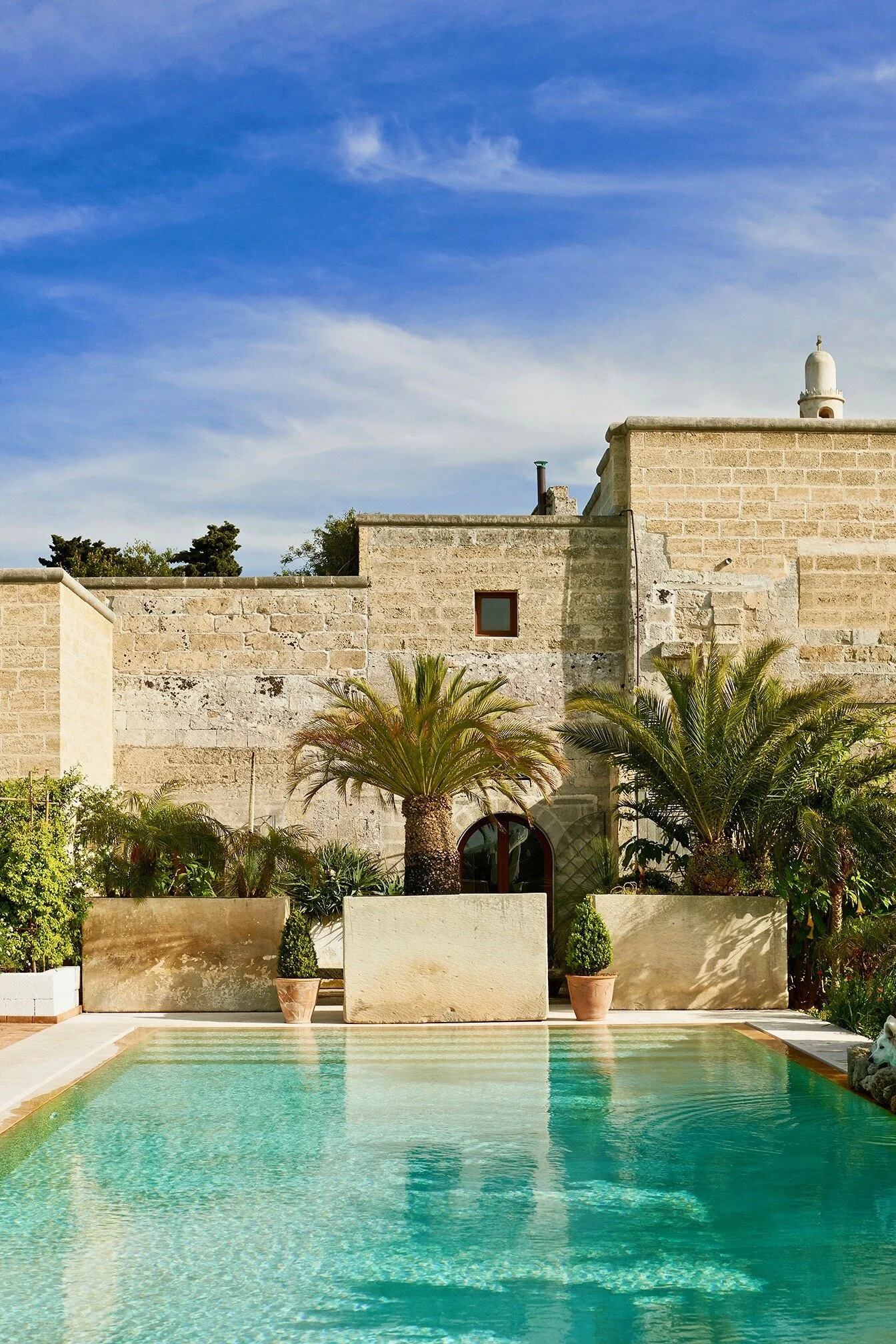
A note on rhythm: this is a stay for the quieter months, when the Salento exhales and Gagliano returns to itself. Ask for the Royal Junior Suite, if only to stand under the rain shower beneath the frescoes once. And if you can gather the right people, the whole palazzo can be taken privately between 1 November and 15 March — all nine suites, the courtyard of orange trees, the pool, the four cooks — which is the closest most of us will come to owning a nineteenth-century Italian palace, for a week, without the burden of the roof.
PROPERTY DNA
Ownership | Independent; a private home that takes a few guests, created by Lord Alistair McAlpine and his wife Athena, who runs it still |
Era & Design | A former Franciscan monastery, roughly 500 years old (14th–15th century); restored by the McAlpines from the early 2000s |
Setting | An unmarked door in a stone wall on the edge of Marittima di Diso, ~2 km from the Adriatic, near the bottom of the Salento |
Rooms | 8 bedrooms — the monks' original cells; sleeps ~15, and can be taken whole |
Designs & Makers | The McAlpines' lived-in collection of folk and tribal art from four continents; in the kitchen, the chef Pierluigi and his mother Cecilia |