
Masseria San Michele: An 18th-Century Farmhouse Rebuilt From Its Own Stone
After years in fashion between Milan and Shanghai, Lorenzo Antonacci came home to the Valle d'Itria and spent three years rebuilding his family's eighteenth-century farmhouse by hand out of its own salvaged stone, olive-press mats, and reclaimed timber.
The Valle d'Itria — the inland plateau where Puglia's trulli (conical dry-stone houses) gather between the Adriatic and the Ionian — has a look that has been photographed nearly to death: the masseria (a fortified Apulian farmhouse) scrubbed to a styled, uniform white and emptied of any sign it once did a day's work. Masseria San Michele, in the countryside outside Martina Franca, is the quiet argument against that version. It keeps its working past in plain sight — in the floors, the doors, the light fixtures — because the man who restored it rebuilt the place out of itself.
That man is Lorenzo Antonacci, who grew up nearby and spent years in the fashion business between Milan, Bologna, and Shanghai before the place pulled him home. The eighteenth-century masseria had been his family's summer house, and he took the restoration on himself — there is no outside design studio anywhere in the story. He gave it three years, most of them spent not decorating but working out how to put the building back together without falsifying it. Because the masseria sits under landscape-heritage protection, the plan had to satisfy the regional conservation office, which suited Antonacci's instinct to keep rather than replace. The work was finished in 2017, and runs to seven rooms — one a family suite, each with its own patio, pared back and earth-toned, furnished with pieces he found and reworked rather than ordered.
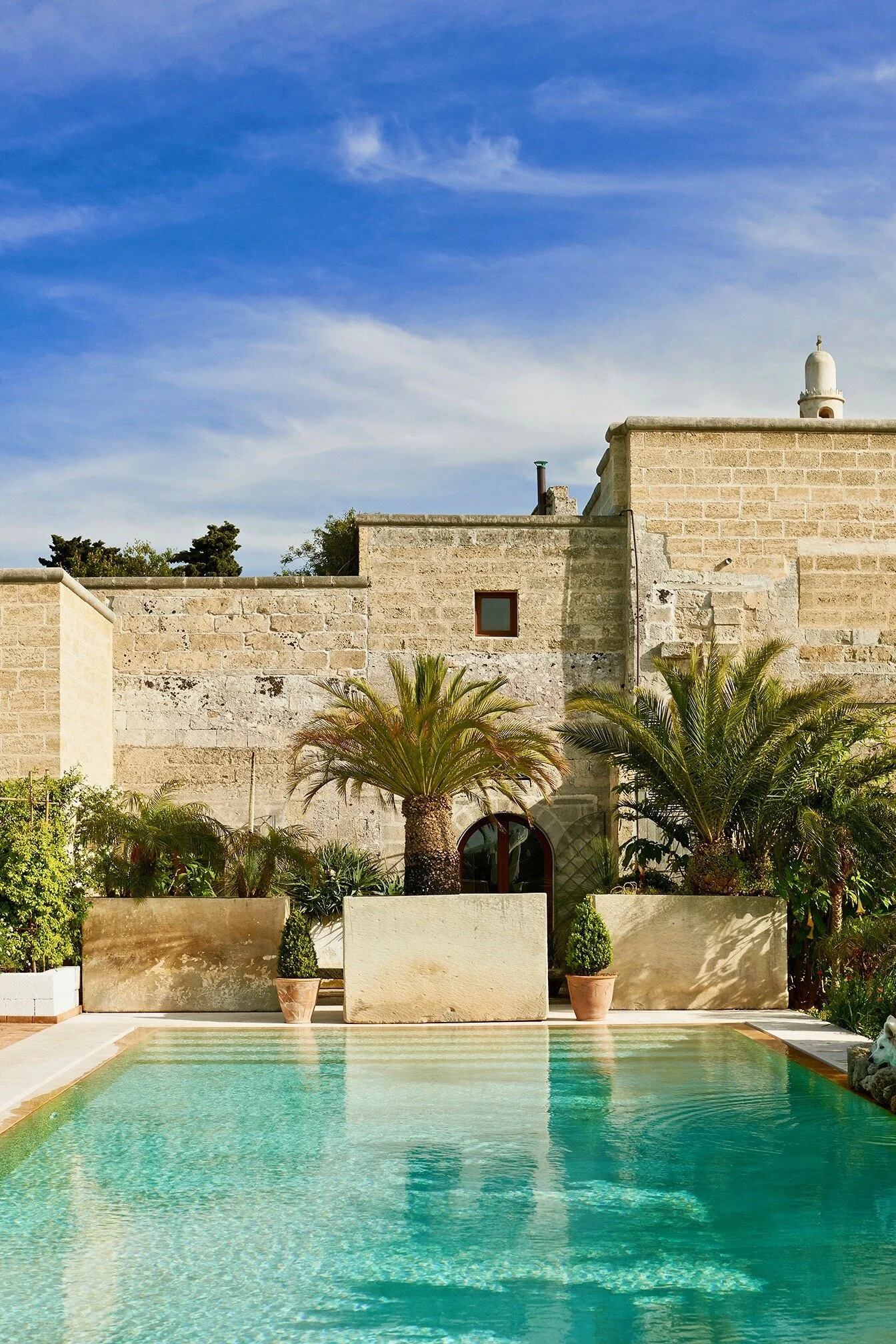 |  |
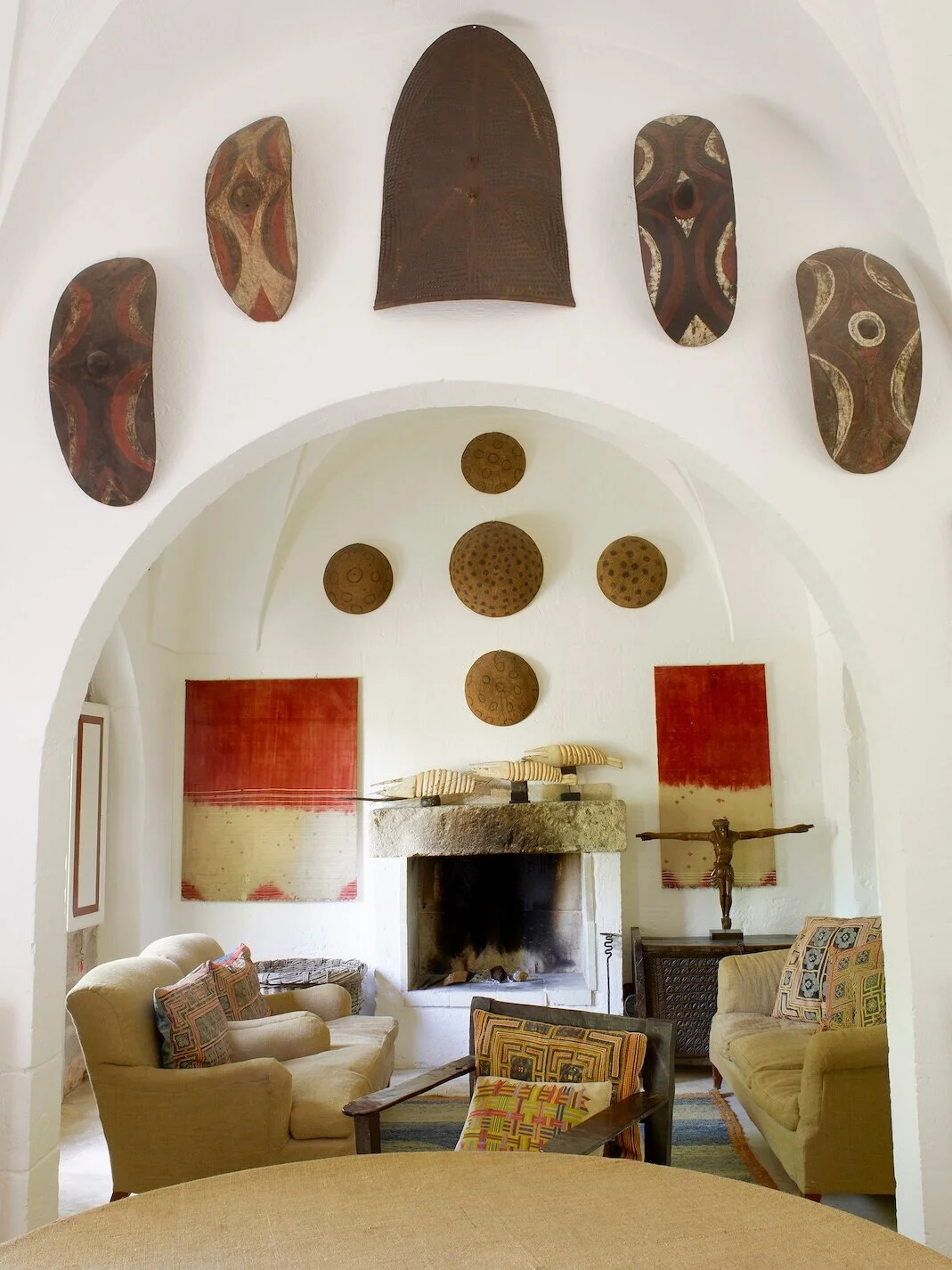
The detail is where San Michele earns the drive. The floors are cocciopesto, the old Pugliese surface of lime and crushed terracotta. The bathroom doors were built from reclaimed iron and oak planks; the outer walls from stone pulled out of nearby quarries. The light fixtures are made from fiscoli — the round fiber mats once used to press olive oil — ringed in salvaged iron. Old chianche (flat stone slabs) were lifted, numbered, and re-laid level, the cisterns beneath them left intact; two palmenti (stone vats for pressing wine) were kept exactly where they stood; the former stables became a sitting room and two of the bedrooms. Even the courtyard was paved in a cement cut with sieved earth. The white that the Valle d'Itria expects of its masserie is here too — but it was reached with eco-minded paint and restraint, not by erasing everything underneath it.
The setting makes the second argument. The masseria stands among centuries-old olive trees and muretti a secco (dry-stone field walls), a short drive from the trulli of Alberobello, the white hill-town of Ostuni, and the balconied lanes of Locorotondo and Cisternino — close enough to reach in a morning, far enough to skip the worst of the crowds they draw. Martina Franca's baroque center is minutes away; Matera and Lecce are each a comfortable day trip. Brindisi airport is about forty minutes off, Bari about fifty, and the golf at Savelletri around fifteen.

What San Michele is, in the end, is small and unhurried: seven rooms, a long breakfast, tastings of the local wine and oil, a cooking or pottery class if you want one, an e-bike to take out into the valley, a saltwater pool to come back to. There is no restaurant theater here and no imported chef, and the restraint is the point — this is a house meant to be lived in slowly rather than performed. Come in May or September, make it your base, and let Alberobello be a morning errand instead of the day's event. Ask Antonacci about the light fixtures; the answer — olive-press mats, saved and turned into something that throws a soft light at dinner — is the whole place in miniature.
PROPERTY DNA
Ownership | Independent; a private home that takes a few guests, created by Lord Alistair McAlpine and his wife Athena, who runs it still |
Era & Design | A former Franciscan monastery, roughly 500 years old (14th–15th century); restored by the McAlpines from the early 2000s |
Setting | An unmarked door in a stone wall on the edge of Marittima di Diso, ~2 km from the Adriatic, near the bottom of the Salento |
Rooms | 8 bedrooms — the monks' original cells; sleeps ~15, and can be taken whole |
Designs & Makers | The McAlpines' lived-in collection of folk and tribal art from four continents; in the kitchen, the chef Pierluigi and his mother Cecilia |