
Convento di Santa Maria di Costantinopoli: A Keyless Salento Monastery With 14 Tons of Books
A Thatcher-era grandee and his wife filled a five-hundred-year-old Salento monastery with fourteen tons of books and the folk art of four continents
There is no sign. On the edge of Marittima di Diso, a small village near the bottom of the Salento, a heavy wooden door is set into a long stone wall and gives no indication of what stands behind it. That absence of announcement is the first true thing about the Convento di Santa Maria di Costantinopoli, and very nearly the most important. There is no front desk, no reception, no television in any of the eight rooms. You arrive as a houseguest, because that is more or less what the place is, a private home that happens to take a few paying friends at a time.
The home belonged to Alistair McAlpine: Lord McAlpine of West Green, builder, prodigious collector, and for years the treasurer of Margaret Thatcher's Conservative Party. He collected the way other people breathe, and somewhere along the way bought this derelict monastery near the heel of Italy and set about filling it. He died in 2014. His wife Athena (Irish-born, of Greek descent, and by all accounts the reason the house still runs as warmly as it does) has kept it almost exactly as it was: which is to say gloriously, deliberately unfinished.
 |  |
The building had earned its scars long before the McAlpines arrived. A Franciscan monastery of roughly five hundred years — McAlpine's own account, in the World of Interiors feature he wrote about his own house, places its origins in the fourteenth century — it was quarried for its stone in the eighteenth by a local bishop, who carted the masonry off to build a church in the next village along. By the twentieth century it had been reduced to a tobacco factory and then, as the story goes, won in a card game by a scrap merchant who kept his livestock and farm machinery inside. The McAlpines found it part-roofless and full of animals. They left a good deal of the wear where it was.
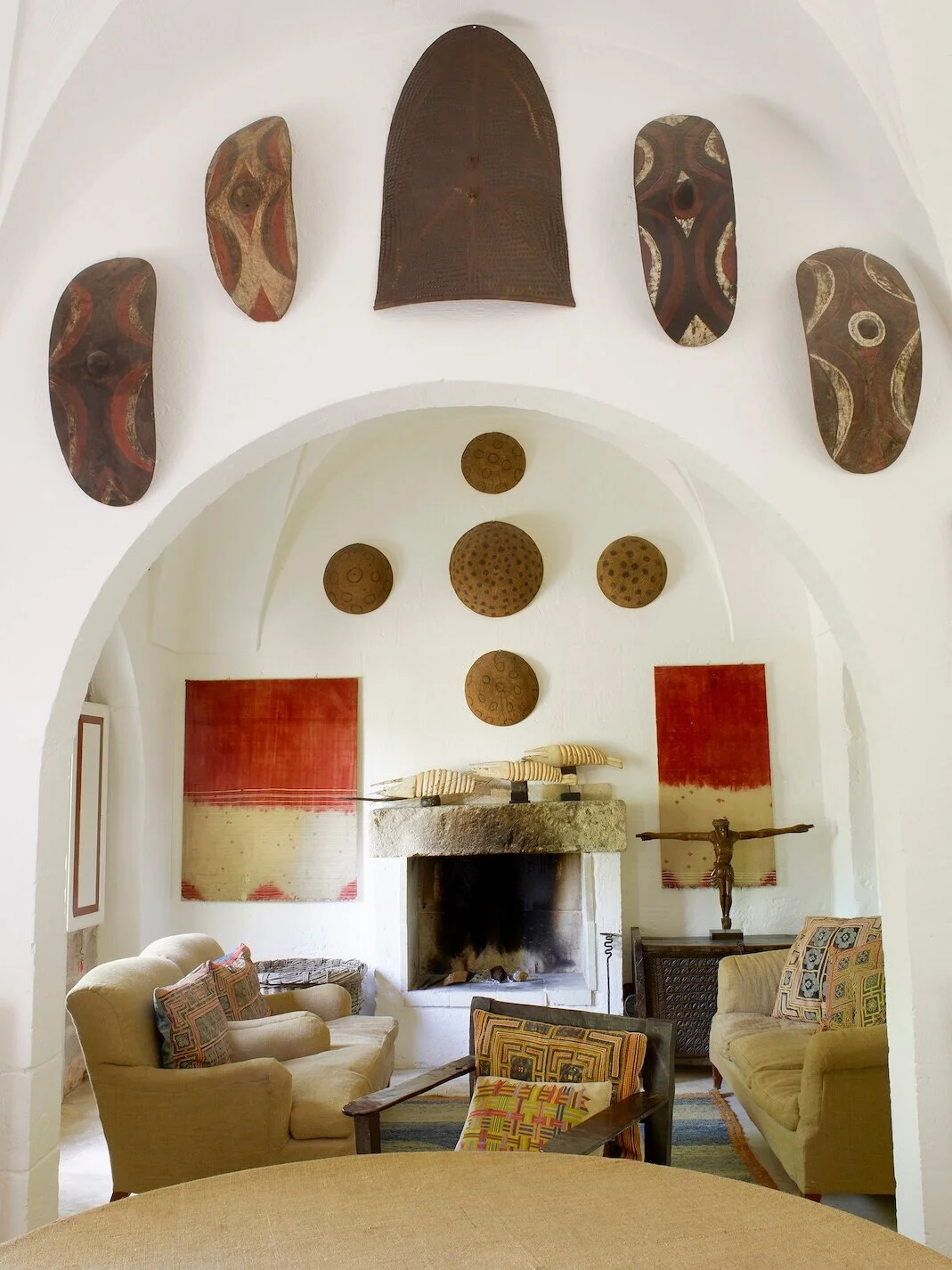
What they added is the reason people talk about the place. The Convento holds a lived-in collection of folk and tribal art gathered from four continents: Navajo weavings from New Mexico, kente cloths from Ghana, a bundle of Ethiopian pilgrims' staffs and a bishop's crozier, nineteenth-century Indian glass paintings, a bust of Gandhi, paintings by the Australian Sidney Nolan; none of it roped off, all of it in daily use. And the books: some fourteen tons of them, stacked on stairs and tabletops and floors, fine first editions shelved among the paperbacks. The whole effect looks, as more than one guest has noted, like a spread from The World of Interiors, which is no accident, given the magazine ran exactly that, in McAlpine's own words.

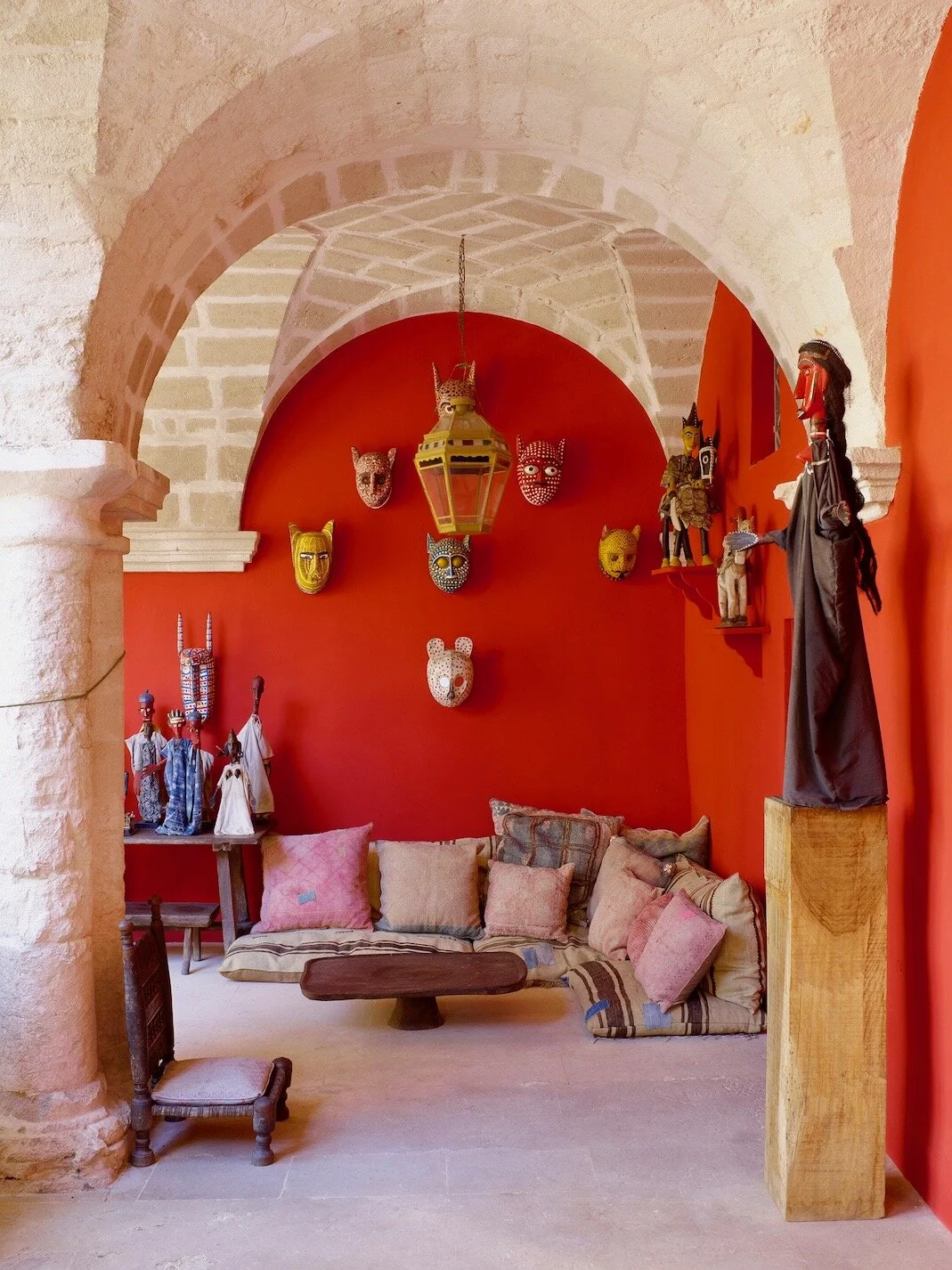
The discipline of the place is in what it refuses. No televisions, no telephones in the rooms, no minibars, and no air conditioning (Athena declines to cut modern ducting into walls of stone three and four feet thick, trusting instead the cross-breeze and the shade that have cooled the cells for five centuries). The eight bedrooms are those original monastic cells, each done up differently, several with their large private bathrooms set across the hall, as in an old family house where nobody thought to mind. The cloistered courtyard at the center, its walls washed a chalky red, is where the day settles, among potted palms, Moroccan rugs, and swallows that nest in the arches.
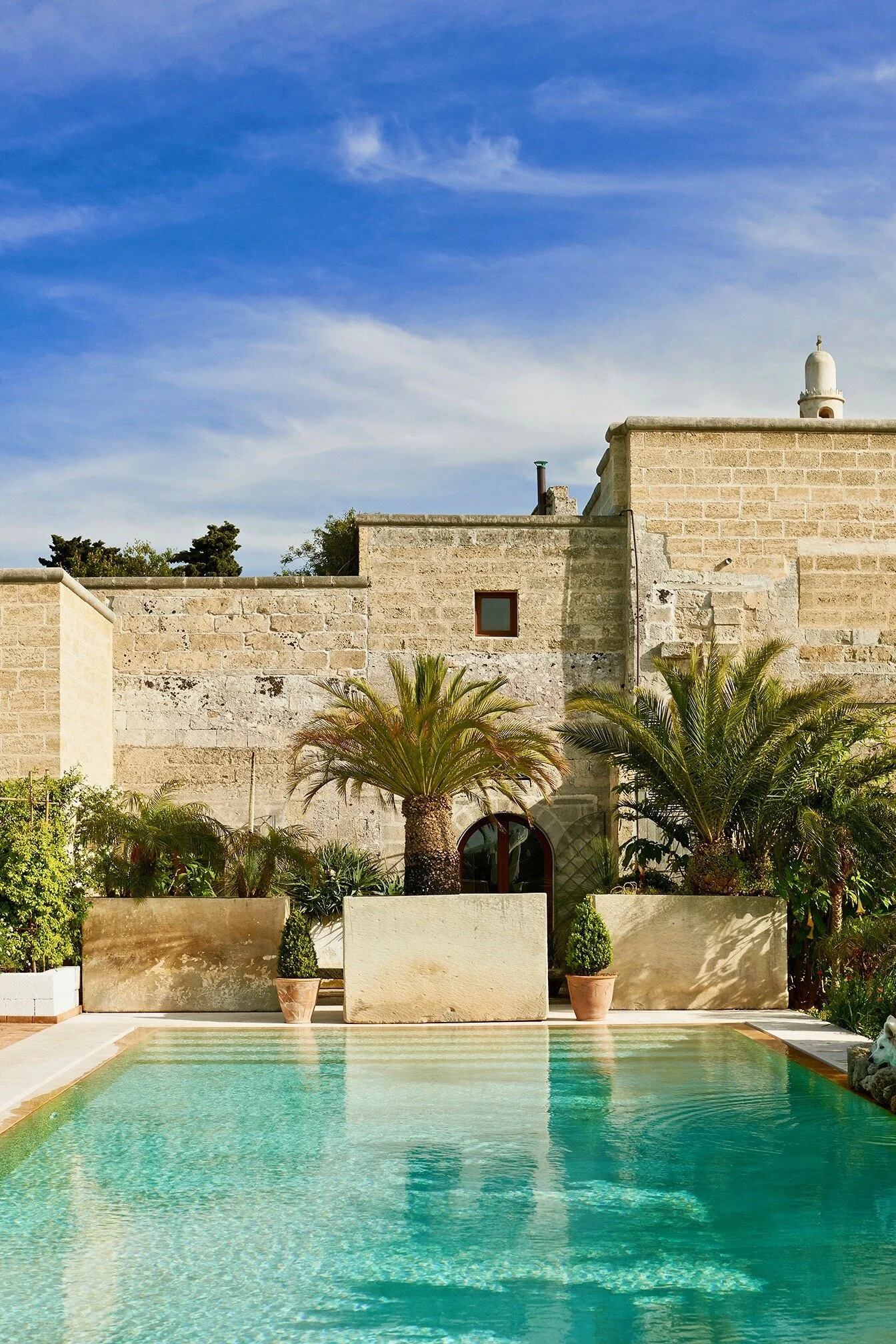
Meals happen in company, around one long oak table, the way a good house party eats. The cooking is done by Pierluigi, a local chef, alongside his mother Cecilia: local fish, vegetables from the garden, house-made grappa, a house rosato (rosé). Breakfast is famously unhurried; it runs until around one in the afternoon, which tells you most of what you need to know about the rhythm of the house. There is a freshwater pool, cooled by water drawn from a deep well, and a rooftop given over to cactus and succulents; massage and yoga can be arranged, but quietly, and only if you ask.
The sea is a couple of kilometers off, reached on foot through olive groves; Otranto is a short drive up the coast, and Lecce and its baroque theatrics are an hour inland. But the Convento is not really a base for sightseeing, and to treat it as one is to miss it. The right way to take it is whole, so gather the people whose company you actually keep, book the entire house (sleeps around fifteen), and stay put. And don't set an alarm, breakfast will wait for you until one.
PROPERTY DNA
Ownership | Independent; a private home that takes a few guests, created by Lord Alistair McAlpine and his wife Athena, who runs it still |
Era & Design | A former Franciscan monastery, roughly 500 years old (14th–15th century); restored by the McAlpines from the early 2000s |
Setting | An unmarked door in a stone wall on the edge of Marittima di Diso, ~2 km from the Adriatic, near the bottom of the Salento |
Rooms | 8 bedrooms — the monks' original cells; sleeps ~15, and can be taken whole |
Designs & Makers | The McAlpines' lived-in collection of folk and tribal art from four continents; in the kitchen, the chef Pierluigi and his mother Cecilia |